
Maine Coon Cat: Complete Breed Guide In 2026
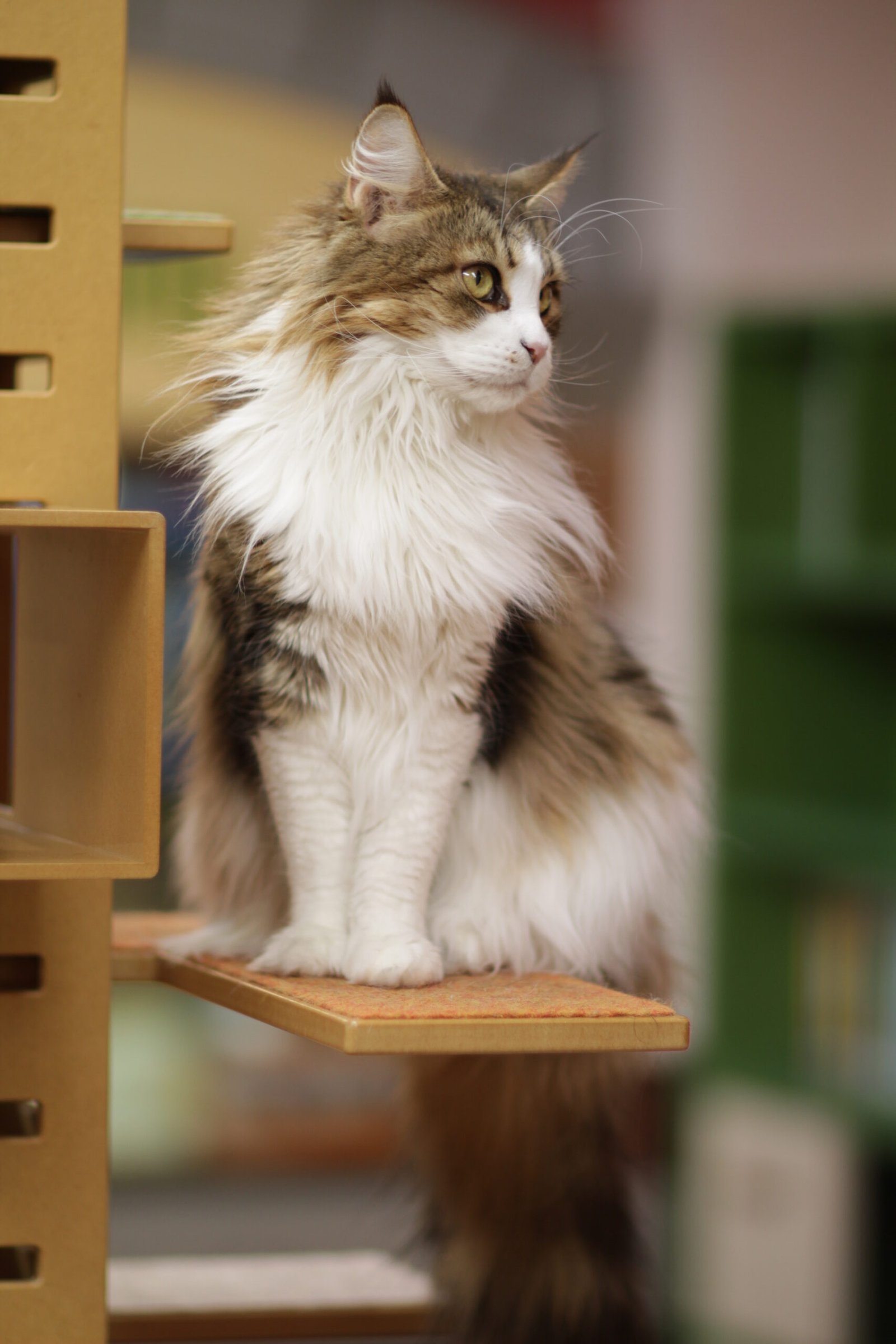
A Maine Coon Cat is the largest domestic cat breed, known for its gentle nature, tufted ears, and long, shaggy coat. Males usually weigh 13 to 18 pounds, females 9 to 13 pounds, and most take 3 to 5 years to reach full size. They are friendly, smart, and good with families, but they need regular brushing and health screening.
This guide covers everything the research found: real size and price ranges, with source disagreements shown honestly, plus temperament, health, grooming, food, colours, and finding a good breeder — so you can decide if a Maine Coon Cat fits your home and budget.
Table of Contents
- What Is a Maine Coon Cat?
- Maine Coon Cat Size and Growth: How Big Do They Get?
- Maine Coon Cat Price and Cost in the USA
- Maine Coon Cat Temperament and Personality
- Maine Coon Cat Health Problems and Screening
- How Long Do Maine Coon Cats Live?
- Grooming a Maine Coon Cat
- What to Feed a Maine Coon Cat
- Maine Coon Cat Colours and Patterns
- Male vs Female Maine Coon Cat
- Maine Coon Cat vs Ragdoll vs Norwegian Forest Cat
- Is a Maine Coon Cat Right for You?
- Maine Coon Kittens and Finding a Good Breeder
- Frequently Asked Questions
- Conclusion
What Is a Maine Coon Cat?
The Maine Coon Cat is a natural breed from Maine, USA. It is the official state cat of Maine since 1985, and one of the oldest natural breeds in North America. The International Cat Association (TICA) lists it as the only native longhaired breed from America among pedigreed cats.
The first written mention dates to 1861, about a cat called “Captain Jenks.” In 1895, a Maine Coon named Cosie won Best Cat at Madison Square Garden, and the CFA gave the breed championship status in 1976.
One old story says Maine Coons are part raccoon — not true, since cats and raccoons cannot have kittens together. The name most likely comes from the bushy tail and brown tabby coat, which look a little like a raccoon.
It is also one of the most popular pedigreed breeds in the USA: Wikipedia’s breed summary lists it as the CFA’s most-registered breed in 2025, ahead of the Ragdoll — a secondary-source claim, so treat it as a sign, not a final fact.
Maine Coon Cat at a Glance
| Fact | Detail |
|---|---|
| Origin | Maine, USA; state cat since 1985 |
| Size | Largest domestic cat breed |
| Adult male weight | 13–18 lb (TICA); up to 25 lb in some guides |
| Adult female weight | 9–13 lb (TICA) |
| Full size | 3–5 years |
| Lifespan | 12–15 years in most guides |
| Coat | Semi-long, heavy, shaggy, water-resistant double coat |
Maine Coon Cat Size and Growth: How Big Do They Get?
Size is the top question about this breed, and sources disagree the most here. The honest answer is a range, not one number.
Adult Weight by Source
| Source | Adult males | Adult females |
|---|---|---|
| TICA | 13–18 lb | 9–13 lb |
| PetMD | Up to 25 lb | 10–14 lb |
| LoveYourCat | 15–25+ lb | Not listed separately |
| CatsFanatic | 13–18 lb, some 20+ lb | 8–12 lb |
TICA is the breed registry, so its range is the safest. PetMD and LoveYourCat list higher top weights, which may include very large males. Note that TICA’s own page says 9–13 lb for females in one passage and 12–15 lb in another — an inconsistency in the source itself.
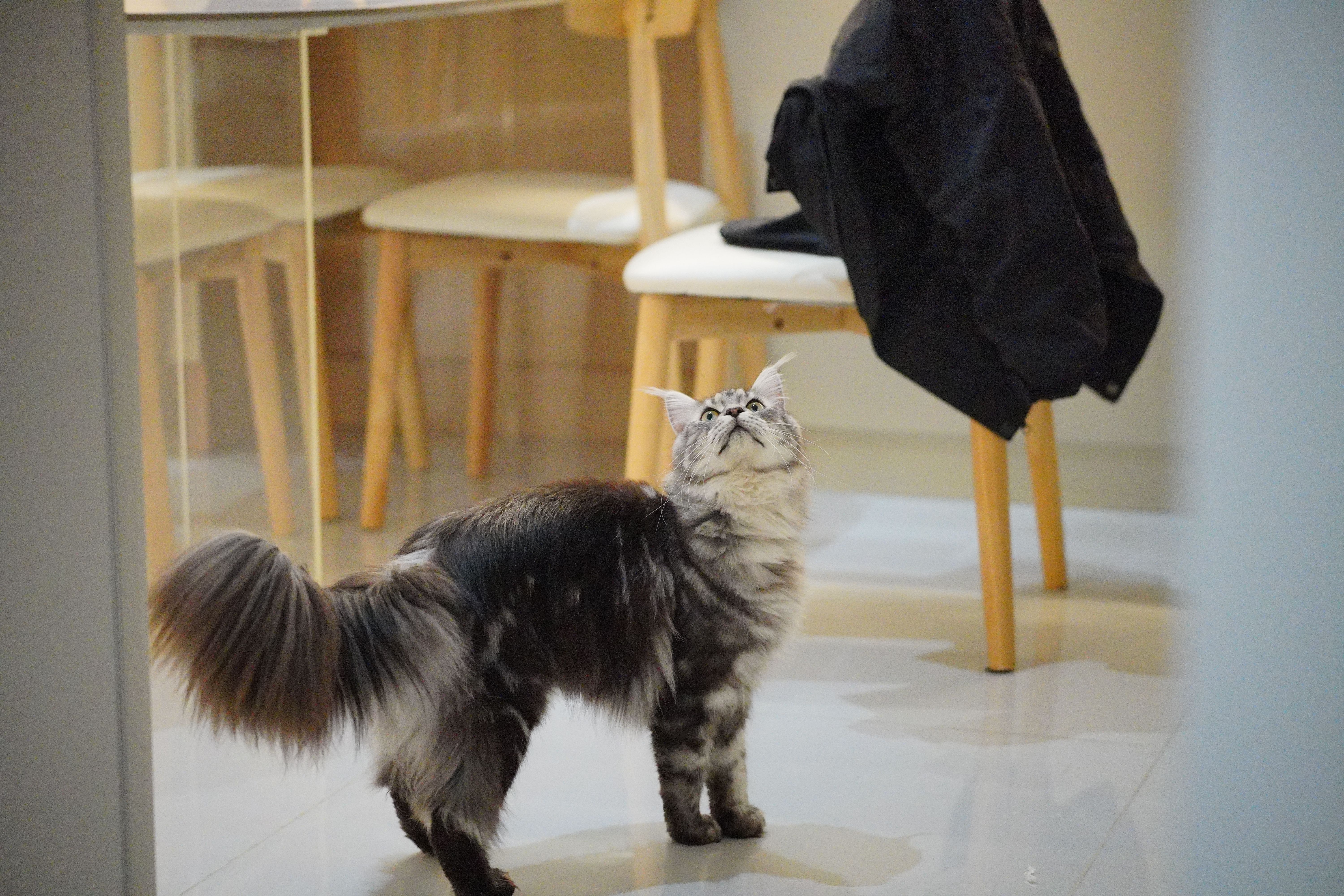
Most sources list 10 to 16 inches at the shoulder and up to 40 inches, nose to tail. The longest domestic cat on record was a Maine Coon named Stewie, at 48.5 inches. Barivel measured 47.2 inches in 2018.
How Long Until Full Size?
A Maine Coon Cat grows slowly: 3 to 5 years to full size (TICA, CatsFanatic, LoveYourCat); some secondary sources cite the CFA at up to 3 years. Most cats finish growing at 12 to 18 months. A Maine Coon grows fast in its first year, then fills out slowly for years.
This slow growth matters for feeding. A Maine Coon should not switch to adult food at 12 months like most cats. Ask your vet when to switch.
Big or overweight? Size alone cannot answer that. A healthy Maine Coon has a clear waist from above and ribs you can feel under a thin layer of fat — ask your vet to check if you are not sure.
Maine Coon Cat Price and Cost in the USA
Price is the second most-asked question, and the numbers disagree here too. PetMD’s breed page still lists $400 to $2,000, but that figure is low and out of date. Every 2026 cost guide puts pet-quality kittens higher.
Price by Tier
| Tier | Price range (USA) | Source |
|---|---|---|
| Pet-quality kitten | $800–$3,500 (Petful $1,000–$2,500; Petzooie $800–$2,500; Furriq $1,800–$3,500) | Petful / Petzooie / Furriq (2026) |
| Breeder-quality kitten | $2,500–$4,000 | Petful |
| Show-quality kitten | $4,000–$8,000 | Petful / Furriq |
| Rescue / adoption | $100–$450 | Petful / Petzooie |
Plan on $1,000 to $3,500 for a pet-quality kitten. Prices below that range should make you ask questions. Petful’s own guide is not fully consistent: its takeaways say rescue costs $100 to $550, while its table says $100 to $400.
What Makes One Kitten Cost More Than Another?
Petful lists six price drivers: health testing, pedigree, colour, polydactyl (extra toes), sex, and geography. Health-tested parents cost more. Rare colours cost more, polydactyl kittens carry a premium of about $300 to $1,000, males often cost more than females, and West Coast catteries usually charge more than Midwest ones.
First-Year, Annual, and Lifetime Cost
The kitten price is only the start. Petful puts the first year at $3,275 to $6,170 (kitten, vet visits, vaccines, food, litter, supplies). Annual costs after that are $1,500 to $3,000 in Petful’s takeaways but $2,056 to $4,070 in its own table. Lifetime cost splits the most: Petful says $25,000 to $55,000, Furriq says $20,000 to $30,000. Plan for the higher end.
A good kitten price includes vaccines, a microchip, registration papers, and a written health guarantee. If a breeder cannot show those, the lower price is not a bargain.
Maine Coon Cat Temperament and Personality
Maine Coons are called gentle giants, and the name fits. TICA describes them as gentle, friendly, and playful. The CFA’s breed notes, quoted in secondary sources, call them sociable, loyal, and intelligent. They are one of the most dog-like cat breeds.
They usually get along well with children, dogs, and other cats, which makes them a good fit for busy family homes. They like company and often follow their owners around, and many greet them at the door like a dog.
They are not usually lap cats. Owners say “near you, not on you”: a Maine Coon will sit beside you and sleep near you, but it may not want to sit on your lap for long. That is normal, not a sign the cat dislikes you.
Maine Coons are vocal in their own way: instead of meowing a lot, they chirp and trill. They are also smart and trainable — many learn fetch, leash walks, and simple tricks.
Do Maine Coons like water? Many are curious about running water and may play with a tap. That does not mean they like to swim — the “water-loving cat” idea is mostly a myth.
Are they aggressive? No, aggression is not a breed trait. A Maine Coon that bites or scratches usually has a reason: pain, fear, or rough handling. If behaviour changes suddenly, see a vet before trying any training fix. They are not low-maintenance: they need daily play, grooming, and company.
Maine Coon Cat Health Problems and Screening
Maine Coons are generally healthy, but the breed is prone to a few conditions — knowing them before you buy is the best protection.
Hypertrophic Cardiomyopathy (HCM)
HCM is the most common heart disease in cats, and Maine Coons are prone to it. The heart muscle thickens, usually in the left ventricle, so the heart pumps less well. Many cats show no early signs. When signs appear, they include laboured or rapid breathing, open-mouthed breathing, and lethargy. Blood clots can paralyse the hind legs. HCM is found with an echocardiogram (heart ultrasound). There is no cure, but medicine and regular checks can manage it. (Cornell Feline Health Center, updated May 2025.)
HCM Screening Checklist — What to Ask a Breeder
- DNA test for MYBPC3 A31P: the known Maine Coon HCM gene mutation. Ask to see the result for both parents.
- Echocardiogram by a board-certified veterinary cardiologist: a heart scan, repeated over time. Ask for the most recent report.
- The key warning: a negative DNA test does not rule out HCM. A cat can test clear for A31P and still develop HCM. Only echo-clear and mutation-negative cats should be bred (TICA).
PetMD and CatsFanatic list HCM but give no screening checklist — do not buy from a breeder who cannot show both the DNA result and a recent heart scan.
How Common Is HCM? The Numbers Disagree
Do not trust any single HCM percentage online: about 30% (Furriq, no source given), about 34% carrying the mutation (Pets Best), 41.5% carrying A31P in a European screen of 2,744 cats (J Vet Cardiol 2010), and about one in three (UFAW). These come from different groups, tests, and years. HCM is common enough that screening is essential.
Hip Dysplasia
Maine Coons have a higher rate of hip dysplasia than most breeds, according to VCA. The hip joint does not form correctly, which leads to arthritis and lameness. Signs include reluctance to jump, stiffness after rest, and a “bunny-hop” gait. Breeders screen hips with X-rays (OFA or PennHIP); keeping your cat lean helps.
Spinal Muscular Atrophy (SMA)
SMA is a nerve and muscle condition found with a DNA test. Signs appear at 3 to 4 months: weakness, a wobbly walk, and tremors. It is not painful, and affected cats can live a normal life. Ask if the parents were tested.
Pyruvate Kinase (PK) Deficiency
PK deficiency is a blood condition that can cause anaemia; TICA notes DNA screening is becoming common, so ask if the breeder tests for it.
Kidney Disease and Dental Problems
Polycystic kidney disease (PKD) causes cysts in the kidneys that can lead to kidney failure, and juvenile gingivitis can start as early as 6 months (both per PetMD). Brush your cat’s teeth 2 to 3 times a week.
Cornell Feline Health Center, HCM page
How Long Do Maine Coon Cats Live?
Most guides list 12 to 15 years; PetMD gives about 13 years, Pets Best and MetLife 9 to 15 years, and Adopt-a-Pet an average of 12.5 years. As with size and price, the range is the honest answer.
One study gives a lower number: a UK VetCompass study from 2024 found a median of 9.71 years at birth (69 deaths, 95% range 8.42–11.00). That was a small sample, not a prediction for your cat.
A longer life comes from the same basics as any cat: healthy weight, good food, dental care, and regular vet visits. No good study ranks the most common causes of death for Maine Coons, so this guide will not invent one. HCM and kidney problems are among the concerns vets watch for, which is why screening and twice-yearly checks matter as the cat ages.
There is no agreed age when a Maine Coon becomes a senior — ask your vet when to start senior care, usually twice-yearly visits with closer checks on joints, teeth, kidneys, and weight.
Grooming a Maine Coon Cat
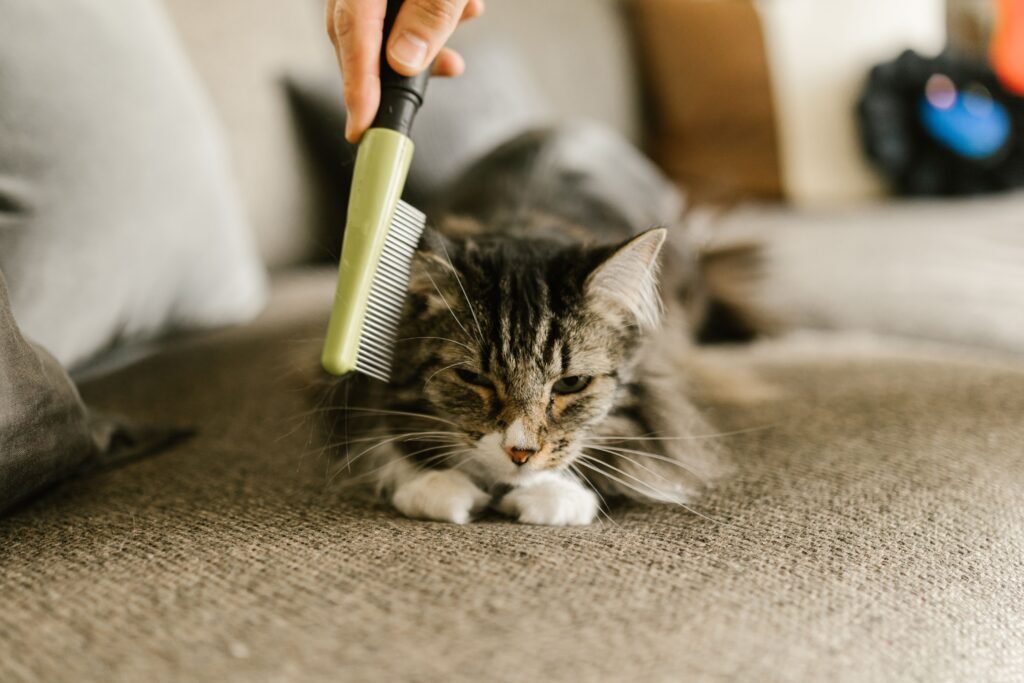
Grooming is where the top articles contradict each other the most. PetMD’s body text says 2 to 3 times a week, but its own FAQ says “daily brushing.” CatsFanatic and Furriq say 3 to 4 times a week, daily in shedding season. TICA’s guidance says daily for cottony coats; older TICA and Vetstreet advice says weekly combing is enough, and VCA’s longhair guidance says daily.
In short: brush 2 to 3 times a week at minimum, daily in spring and fall shedding season. Soft, cottony coats need daily attention.
A Practical Grooming Routine
- Comb first, then brush. Use a wide-tooth steel comb to find tangles, then a brush to smooth the coat — a slicker brush alone glides over mats without removing them.
- Check the mat zones every time: armpits, belly, backs of the legs (britches), behind the ears, and the base of the tail.
- Never cut a mat out with scissors — skin folds hide inside mats. Use a mat splitter or ask a groomer or vet to remove tight mats.
- Baths: every 4 to 8 weeks (Petzooie), unless the coat gets greasy or dirty.
- Nails: every 2 to 3 weeks for adults, weekly for kittens (TICA); every 10 days to 2 weeks (Vetstreet).
- Teeth: brush 2 to 3 times a week.
Maine Coons shed year-round, with a heavier coat blow in spring and fall. Regular brushing controls loose fur and reduces hairballs. Some owners ask about a summer “lion cut” — ask your vet first.
What to Feed a Maine Coon Cat
Maine Coons need good food in the right amount, because they grow for years and reach a large size. Protein matters most: the AAFCO minimum is 26% for adults and 30% for growing kittens, while Petzooie’s guide suggests 35 to 45% protein on a dry-matter basis. The same guide suggests 25 to 30 calories per pound of body weight per day.
TICA suggests about two-thirds to three-quarters of a cup per day for an adult. Treat that with care: it most likely refers to dry food only, and the right amount depends on the food’s calorie count, the cat’s weight, and activity. Check the bag’s feeding guide and ask your vet.
Wet food, dry food, or raw food? PetMD’s advice is to ask your vet and follow the food’s feeding guide. Wet food adds water, which helps kidneys. Dry food is easy to store and feed. Raw food needs careful handling and vet guidance — there is no one best choice for every cat.
Because Maine Coons grow until age 3 to 5, they usually stay on kitten food longer than other breeds. Do not switch at 12 months by default — ask your vet when your cat is ready.
Some human foods are toxic to cats — garlic is not safe. If you are unsure about a food, check before you offer it. Our guide explains the risk: https://mypetscreature.com/can-cats-eat-garlic/
Maine Coon Cat Colours and Patterns
Maine Coons come in more than 75 colour and pattern combinations, according to TICA. There is one breed, not several types, and the colour does not change the temperament.
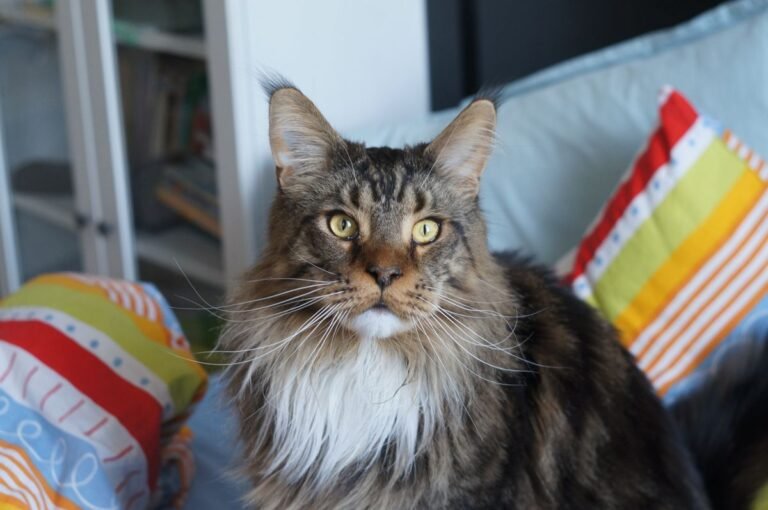
The most common colour is the brown tabby, in classic or mackerel pattern. Other common colours include black, white, blue, red (often called orange), cream, silver and smoke, tortoiseshell, calico, and bi-colour. Some colours cost more than others.
Two colour rules matter for buyers: pointed colours (colourpoint) are not accepted in the breed standard, and chocolate and lavender are not accepted by the CFA. A breeder selling a “rare chocolate Maine Coon” at a high price is selling a colour the standard does not recognise.
Polydactyl Maine Coons
Polydactyl means extra toes. About 40% of Maine Coons were historically polydactyl, according to Adopt-a-Pet, citing Tufts University. TICA recognises Maine Coon Polydactyls as a variety. Extra toes do not harm the cat. Polydactyl kittens usually cost $300 to $1,000 more than standard kittens (Petful).
Male vs Female Maine Coon Cat
Males are bigger than females. Breeder guides often list males at 18 to 22 pounds and females at 12 to 15 pounds, while TICA lists 13 to 18 pounds for males and 9 to 13 pounds for females. The breeder numbers sit at the high end, so use TICA’s range as the safe baseline.
Personality differences are trends, not rules. Breeder guides often describe males as more affectionate and goofy, and females as more independent. MaineCoonCentral adds the key point: the individual cat matters more than its sex — meet the kitten before you decide.
Males often cost more than females. And male cats in general face a higher risk of urinary blockage, a painful emergency — ask your vet about the warning signs: straining in the litter box, crying while urinating, or not urinating at all.
Maine Coon Cat vs Ragdoll vs Norwegian Forest Cat
People often compare the Maine Coon Cat with the Ragdoll and the Norwegian Forest Cat — all big and gentle, with differences smaller than the similarities.
Maine Coon Cat vs Ragdoll
The Ragdoll is the breed the Maine Coon passed in CFA registrations in 2025 (Wikipedia’s breed summary). Both are large, gentle, and need regular grooming. The clearest difference is genetic: Maine Coons carry the HCM mutation MYBPC3 A31P, Ragdolls carry a different one, R820W. Screening is the same — DNA test plus heart scans — but the gene tested differs.
Maine Coon Cat vs Norwegian Forest Cat
The Norwegian Forest Cat is the other large, longhaired natural breed, and the two can look alike at first glance. The differences are in the head shape, muzzle, and coat texture, and they are easier to see in photos than in words: the Maine Coon has a squarer muzzle and more visible ear tufts, the Norwegian Forest Cat a straighter profile.
Maine Coon Cat vs Normal Cat
Compared with a regular domestic shorthair, the Maine Coon is bigger in every way. It takes 3 to 5 years to reach full size, while most cats finish growing at 12 to 18 months. It eats more, sheds more, needs more grooming, and costs more. In return, it is more social and more dog-like. If you want a big, friendly cat and you have the time and budget, the Maine Coon is a strong choice. If you want a low-maintenance pet, a normal cat is easier.
Is a Maine Coon Cat Right for You?
A Maine Coon Cat is a wonderful pet for the right home and a poor fit for the wrong one. First-time owners do well with this gentle breed, but the grooming, size, and cost surprise many new owners. Use this honest list to decide.
Reasons to get one:
- Gentle with children, dogs, and other cats
- Smart and trainable
- Social and loyal
- Beautiful, with many colours
- Long-lived for a large breed
Reasons to think twice:
- Heavy shedding all year, worse in spring and fall
- Brushing 2 to 3 times a week, daily in shedding season
- High food and vet costs
- Slow to mature — keeps growing for 3 to 5 years
- Needs company; gets bored and unhappy alone
- Everything is oversized: litter box, carrier, tree, bowls
Apartment and Indoor Living
Maine Coons can live in apartments and as indoor-only cats. They need space and enrichment more than a garden: a sturdy 6-foot-plus cat tree, a scratching post that will not tip over, and an extra-large litter box. Do not leave one unsupervised outdoors — theft is a real risk.
Can They Be Left Alone?
No top article gives an authoritative answer — owner forums are the only source, often saying 8 to 12 hours and suggesting a second cat for company. Treat that as forum-level advice, not a vet recommendation. Maine Coons bond closely with their people and dislike long absences, so if you work long hours away every day, a pair of cats or a different breed may suit you better.
Maine Coon Kittens and Finding a Good Breeder
The First Week at Home
Kittens usually go home at 12 to 16 weeks. Before your kitten arrives, buy giant-breed supplies: an extra-large litter box, a sturdy 6-foot-plus cat tree, and a large carrier. Settling in: give the kitten a quiet room with food, water, a litter box, and a hiding place. Book the first vet visit within a few days, with the breeder’s health records.
How to Find a Reputable Breeder
- Use the TICA and CFA breeder directories — the official lists.
- Check the Maine Coon Breeders and Fanciers Association (MCBFA) code of ethics. Good breeders follow it.
- Ask for health paperwork for both parents: MYBPC3 A31P DNA results, recent echocardiograms, hip X-rays, and SMA and PK deficiency results.
- Visit or video-call to see where the kittens live. They should be raised inside the home, not in cages or sheds.
- Expect a wait: good breeders often have a waitlist of 6 months or more.
- Expect a written contract and health guarantee.
Red Flags and Scams
Walk away if the breeder cannot show health test results, wants the kitten to leave before 12 weeks, has no written contract, or asks for full payment by gift card or wire transfer before you have seen the kitten. Prices far below the market range are a warning sign, not a bargain.
Rescue is the other route, but purebred Maine Coons are rare in shelters — most “Maine Coons” there are mixes. Do not pay a purebred price for a mix.
Frequently Asked Questions
How big do Maine Coon cats get?
Adult males usually weigh 13 to 18 pounds, according to TICA, though some sources list up to 25 pounds. Females are smaller, at 9 to 13 pounds. Most Maine Coons reach full size slowly, between 3 and 5 years of age, and can measure up to 40 inches from nose to tail.
How much does a Maine Coon cat cost in the USA?
A pet-quality Maine Coon kitten in the USA usually costs between $1,000 and $3,500, depending on the breeder, region and colour. Show-quality kittens can cost $4,500 to $8,000. Rescue adoption is far cheaper, usually $100 to $400, although purebred Maine Coons are rare in shelters.
Are Maine Coon cats hypoallergenic?
No. Maine Coon cats are not hypoallergenic. They produce normal amounts of Fel d 1, the protein in saliva and skin that triggers most cat allergies. No cat breed is truly hypoallergenic. Allergy sufferers can still live with one by brushing often, cleaning bedding, and using air filters, but symptoms may remain.
How long do Maine Coon cats live?
Most guides list 12 to 15 years. PetMD gives about 13 years. A UK VetCompass study from 2024 found a median of 9.71 years, but that was a small population sample, not a prediction for one cat. Good food, weight control, dental care and regular vet checks help a Maine Coon live longer.
What health problems do Maine Coon cats have?
The main health problems are hypertrophic cardiomyopathy (HCM), hip dysplasia, spinal muscular atrophy (SMA) and pyruvate kinase (PK) deficiency. HCM is the most serious. Ask breeders for MYBPC3 DNA test results and heart scans, because a clear DNA test alone does not rule out HCM.
Conclusion
The Maine Coon Cat is the largest domestic cat breed and one of the gentlest. It grows slowly, taking 3 to 5 years to reach full size, and it needs more food, more grooming, and more money than a normal cat. In return, you get a loyal, smart, social companion.
Before you buy, remember three things: check the breeder’s health screening, especially the HCM DNA test and heart scans; budget honestly for the first year and after; and make sure you have time for brushing, play, and company. A Maine Coon Cat is a long commitment.
For more cat care guides, visit MyPetsCreature: https://mypetscreature.com/
General information only — not veterinary advice

MyPetsCreature is a trusted digital resource dedicated to providing well-researched, human-centric insights into pet care, health, and behavior. Our team of passionate pet enthusiasts delivers reliable advice, comprehensive guides, and essential tips to help pet parents worldwide ensure the well-being and happiness of their companion animals.

9 Comments