
Are White Cats With Blue Eyes Deaf? Science Explained
Not all of them, but white cats with blue eyes are more likely to be deaf than other cats. The risk comes from the dominant white gene, which can prevent pigment cells from reaching the inner ear during development. Research reviews report that a majority of white cats with two blue eyes show some degree of deafness, while white cats with green or yellow eyes are much less affected.
This guide explains the science behind the link between white coats, blue eyes, and hearing, how common deafness really is, how vets test for it, and how to give a deaf cat a safe, happy life. You will also learn why blue-eyed Siamese cats are a completely different case.
Table of Contents
- The Short Answer: Blue Eyes and Deafness Risk
- The Dominant White Gene and the Inner Ear
- How Common Is Deafness in White Cats?
- Odd-Eyed Cats: One Blue Eye, One Hearing Ear?
- Blue Eyes in Siamese vs. White Cats: A Different Story
- BAER Testing: How Vets Check Feline Hearing
- Living With a Deaf Cat
- White Cats and Sun Sensitivity
- Should You Worry About Your White Cat?
- Frequently Asked Questions About Deafness in White Cats
Section 1: Blue Eyes and Deafness Risk
White cats with blue eyes carry a higher risk of congenital deafness — hearing loss present from birth. The cause is not the blue eyes themselves, but the underlying genetics. The dominant white gene that makes the coat white can also stop pigment-producing cells from migrating to the inner ear, where they are needed for normal hearing development.
The risk is highest in solid white cats with two blue eyes, lower in odd-eyed cats (one blue, one other color), and lowest in white cats with non-blue eyes. Importantly, many white cats with blue eyes hear perfectly well. Blue eyes raise the odds; they do not guarantee deafness.
Section 2: The Dominant White Gene and the Inner Ear
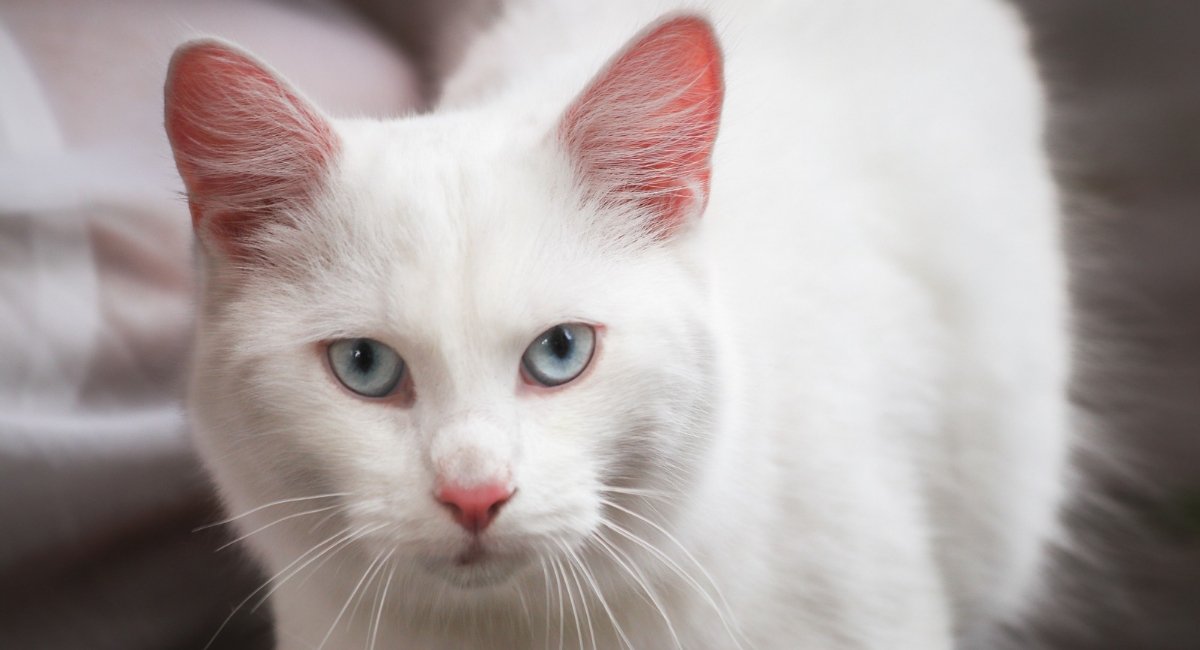
Most solid white cats are white because of the dominant white gene, a change in the KIT gene. It suppresses pigment cells (melanocytes) as they spread through the developing embryo, masking whatever coat color and pattern the cat would otherwise have. A dominant white cat could genetically be tabby, black, or colorpoint underneath — you would never know from looking.
The same migration failure affects the inner ear. A tiny structure in the cochlea called the stria vascularis needs melanocytes to maintain the electrical balance that lets hair cells detect sound. Without them, the cochlea can degenerate in the first few weeks of life, causing permanent sensorineural deafness. This is why the link is specifically with the dominant white gene, not with white markings like socks or blazes on an otherwise colored cat.
The iris connection is the same story in miniature. Melanocytes that fail to reach the iris leave it without pigment, and an unpigmented iris scatters light and looks blue. So the blue eyes and the hearing risk are two visible and invisible outcomes of one developmental event.
Section 3: How Common Is Deafness in White Cats?
Veterinary research reviews consistently find a strong pattern: white cats with blue eyes are far more likely to be deaf than white cats with other eye colors. Reviews of the published data report that roughly two-thirds or more of white cats with two blue eyes have some hearing impairment, compared with a much smaller fraction of white cats with green or yellow eyes.
Deafness can be total or partial, and in one ear or both. A cat deaf in one ear may behave almost normally, which is why owners are sometimes surprised by a diagnosis. Kittens are born with closed ear canals that open around two weeks of age, so hearing problems linked to this gene are present from the start rather than developing later.
These are population-level odds, not individual predictions. Plenty of blue-eyed white cats hear normally, and the only way to know for sure about your cat is a proper hearing test, not guesswork based on eye color.
Section 4: Odd-Eyed Cats: One Blue Eye, One Hearing Ear?
Odd-eyed cats — one blue eye and one green, yellow, or copper eye — sit in the middle of the risk spectrum. The common pattern is that if hearing loss occurs, it tends to affect the ear on the blue-eyed side. A cat with one blue eye and one green eye that is deaf will often be deaf only on the blue-eyed side.
This makes intuitive sense given the mechanism: pigment cell migration can fail more completely on one side of the head than the other. The result is heterochromia plus single-sided deafness. Many odd-eyed cats hear well enough with their good ear that owners never notice anything unusual.
Single-sided deafness is easy to miss at home because the cat compensates. You might notice the cat startles more easily when approached from one side, or seems to locate sounds less precisely. A BAER test is the only reliable way to confirm it.
Section 5: Blue Eyes in Siamese vs. White Cats: A Different Story
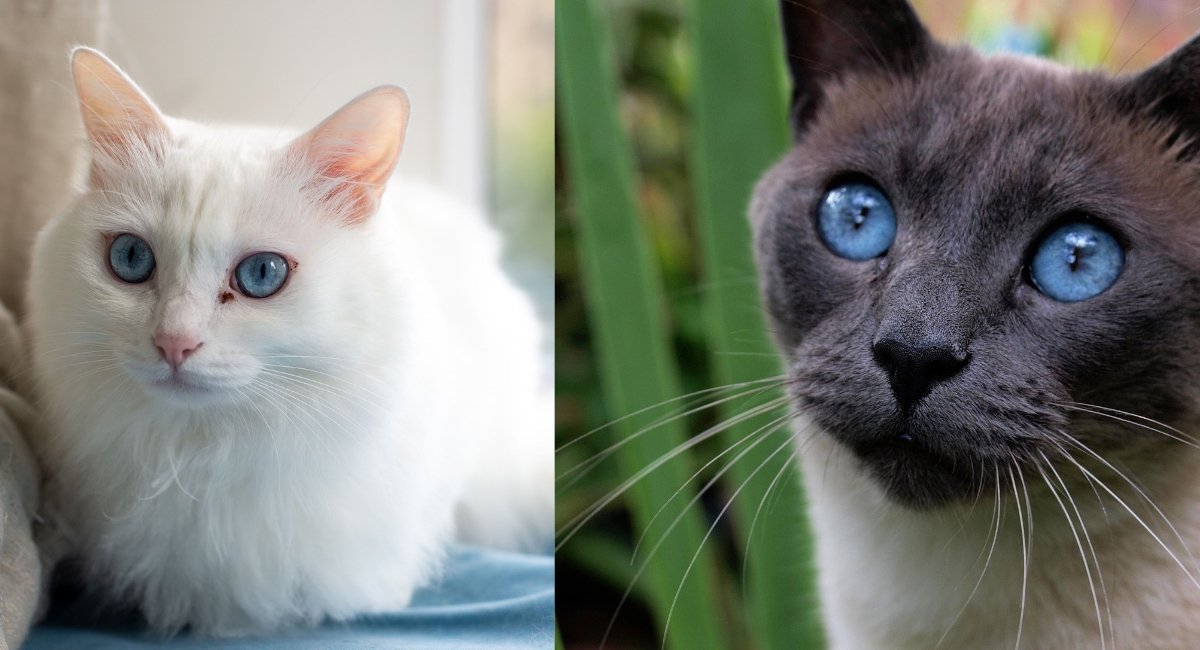
This is the distinction that confuses many owners. Siamese cats always have blue eyes, yet they do not carry the deafness risk of dominant white cats. That is because Siamese blue eyes come from an entirely different gene — the temperature-sensitive TYR change behind the colorpoint pattern — which reduces iris pigment without affecting the inner ear.
The table below summarizes the key differences.
| Feature | Siamese (Colorpoint) | Solid White (Dominant White) |
|---|---|---|
| Gene responsible | TYR (temperature-sensitive) | KIT (dominant white) |
| Why eyes are blue | Low iris pigment from birth | Pigment cells never reached the iris |
| Deafness risk | Not linked to the coat gene | Higher, especially with two blue eyes |
| Inner ear affected? | No | Can be, in the first weeks of life |
| Eye color options | Always blue | Blue, green, yellow, or odd-eyed |
| How to confirm hearing | Not routinely needed | BAER test recommended |
If you are trying to figure out whether your blue-eyed cat is a pale Siamese or a solid white cat, our guide on white Siamese cats with blue eyes walks through the visual differences, from faint points to body shape to registration papers.
Section 6: BAER Testing: How Vets Check Feline Hearing
BAER stands for brainstem auditory evoked response. It is the gold standard for testing hearing in cats and dogs. Small electrodes placed on the head measure the brain’s electrical response to clicks played through earphones, one ear at a time. The test is painless, though most cats need light sedation to stay still.
BAER gives a definitive answer for each ear separately: normal hearing, partial loss, or complete deafness. This matters because behavioral tests at home are unreliable — cats are masters at using vibration, sight, and their other ear to fake normal hearing.
Vets generally recommend BAER testing for solid white kittens with blue eyes before they go to new homes, so buyers know exactly what they are getting. If you are adopting or buying a white blue-eyed cat, ask whether the test has been done. For more on white-coated breeds and their care, see our grayish-white cat breeds guide.
Section 7: Living With a Deaf Cat
Deaf cats live full, happy lives with a few adjustments. The single most important rule is safety: a deaf cat cannot hear cars, dogs, or warning shouts, so it should live indoors or in a secure enclosed outdoor space such as a catio.
Communication shifts from voice to vibration and sight. Stomp gently on the floor to get attention through vibration, use hand signals and flashlight flickers for cues, and always approach within the cat’s line of sight so you do not startle it. Many owners are amazed how quickly deaf cats learn routines — mealtime, playtime, and bedtime all run on schedule and body language.
Consider a breakaway collar with a bell so you can hear where the cat is, and let visitors know the cat is deaf so they approach thoughtfully. Deaf cats can be slightly more easily startled, so waking them with a gentle floor vibration rather than a touch prevents a frightened scratch.
Section 8: White Cats and Sun Sensitivity
Hearing is not the only special consideration for white cats. White cats with pink ears and noses are prone to sunburn, and chronic sun exposure can lead to squamous cell carcinoma, a skin cancer, on the ear tips and nose. This risk applies regardless of eye color.
Limit direct sunbathing, especially during peak hours, and ask your vet about pet-safe sun protection for the ears. Any crusty, non-healing sore on a white cat’s ears or nose deserves a prompt vet check. Indoor living, which deaf cats need anyway, neatly solves most of the sun problem too.
Section 9: Should You Worry About Your White Cat?
Worry is the wrong word; awareness is the right one. If your white cat has blue eyes, arrange a BAER test so you know the hearing status of each ear. Then adapt: indoor living, vibration-based communication, and sun protection. That is genuinely the whole program, and deaf cats thrive on it.
If your white cat has green or yellow eyes, the deafness risk is low and no special testing is routine — just the same good care every cat deserves. And if your blue-eyed cat is actually a Siamese or Siamese mix, the white-cat deafness link does not apply at all.
Section 10: Frequently Asked Questions About Deafness in White Cats
Are all white cats with blue eyes deaf?
No. The risk is significantly higher than in other cats, and research reviews suggest a majority of white cats with two blue eyes have some hearing loss — but many hear normally. Only a BAER test gives a certain answer for an individual cat.
Can a white cat be deaf in only one ear?
Yes, and this is common in odd-eyed cats, where the deafness often affects the ear on the blue-eyed side. Single-sided deafness is easy to miss because the cat compensates well with the hearing ear.
Is the deafness in white cats treatable?
No. Congenital sensorineural deafness from the dominant white gene involves degeneration of inner ear structures in early life and is permanent. Management focuses on safety and communication, not cure — and deaf cats adapt remarkably well.
Do blue-eyed Siamese cats go deaf?
No, not from their coat genetics. Siamese blue eyes come from the colorpoint TYR gene, which does not affect the inner ear. Siamese cats can develop age-related hearing loss like any senior cat, but that is unrelated to their eye color.
How much does a BAER test cost?
Costs vary by region and clinic, but BAER testing typically runs in the low hundreds of dollars and requires light sedation. Ask your vet for a referral to a neurology or specialty practice if your regular clinic does not offer it.
Can deaf cats go outside?
Only in secure enclosed spaces. A deaf cat cannot hear traffic, predators, or calls to come home, so free roaming is unsafe. A catio, enclosed patio, or leash walks in a quiet area give safe outdoor enrichment.
Conclusion
White cats with blue eyes face a real but manageable risk of congenital deafness, driven by the dominant white gene’s effect on inner ear development. The risk is highest with two blue eyes, moderate in odd-eyed cats, and low with other eye colors — and Siamese blue eyes are an entirely separate, safe case.
Get a BAER test to know where your cat stands, keep the cat safely indoors, communicate with vibration and sight, and protect those pink ears from the sun. With those simple steps, a deaf white cat lives just as rich a life as any hearing cat.

MyPetCreature is a trusted digital resource dedicated to providing well-researched, human-centric insights into pet care, health, and behavior. Our team of passionate pet enthusiasts delivers reliable advice, comprehensive guides, and essential tips to help pet parents worldwide ensure the well-being and happiness of their companion animals.






One Comment